
Time is one of the most valuable resources an entrepreneur has. Unlike money, you cannot earn more of it. Every business owner gets the same 24 hours each day. Therefore, how you use those hours often determines your success.
Many entrepreneurs struggle with competing priorities, constant interruptions, and long to-do lists. As a result, important work often gets pushed aside. Fortunately, effective time management can help you stay focused, reduce stress, and accomplish more.
The goal is not to work longer hours. Instead, the goal is to spend your time on the activities that create the greatest impact.
Understand Where Your Time Goes
Before improving your schedule, you need to understand how you currently spend your time.
For one week, track your daily activities. Record meetings, emails, administrative work, customer support, and project tasks. Then review the results.
Many business owners discover they spend significant time on low-value activities. Meanwhile, important tasks such as sales, marketing, and strategic planning receive less attention.
Once you identify time drains, you can make better decisions about where to focus your energy.
Need help with time management and managing your business more effectively?
Try Ask Aston to brainstorm ideas, validate opportunities, create business plans, and get step-by-step guidance tailored to your goals.
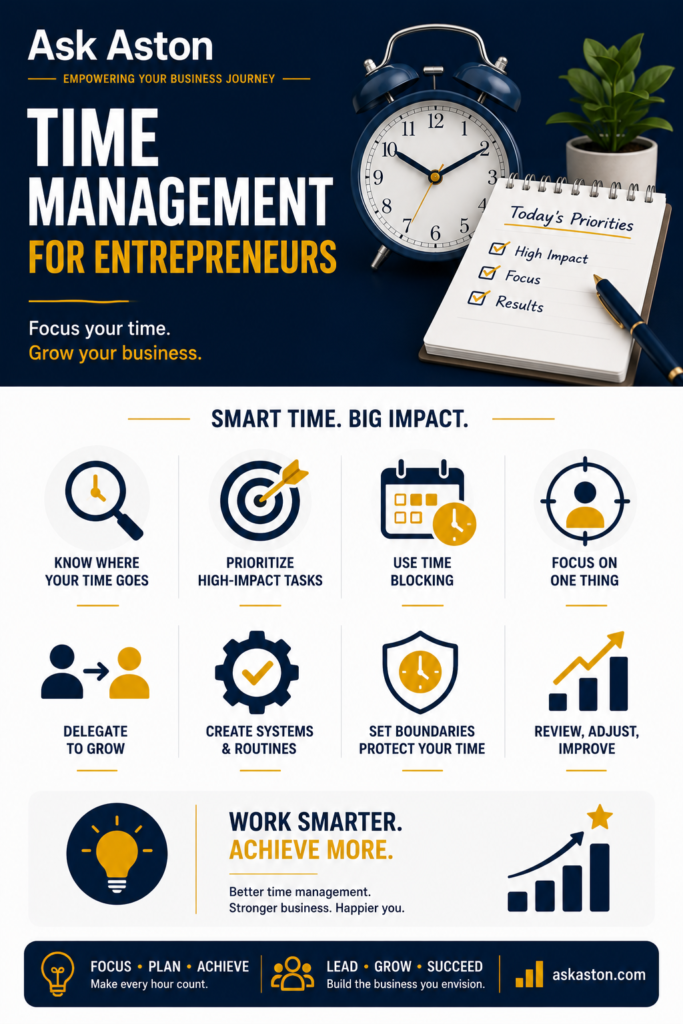
Prioritize High-Impact Tasks
Not all tasks contribute equally to business growth.
Some activities directly generate revenue, attract customers, or improve operations. Others simply keep you busy. Therefore, prioritize tasks that create the greatest value.
At the beginning of each day, identify your top three priorities. Complete those tasks before moving on to less important work.
Additionally, tackle difficult projects during your most productive hours. Many entrepreneurs have more energy and focus in the morning. If that applies to you, schedule important work early in the day.
Use Time Blocking
Time blocking is one of the simplest and most effective productivity techniques.
Instead of reacting to tasks as they appear, assign specific blocks of time to different activities. For example, you might dedicate the morning to sales calls, the afternoon to client work, and the final hour of the day to email. This approach reduces distractions and improves concentration.
Furthermore, time blocking helps prevent small tasks from consuming your entire day.
A structured calendar often leads to better results than a long task list.
Avoid Constant Multitasking
Many entrepreneurs pride themselves on multitasking. However, research consistently shows that switching between tasks reduces productivity.
Each interruption requires your brain to refocus. Consequently, projects take longer to complete and mistakes become more common. Instead, focus on one task at a time whenever possible.
Turn off unnecessary notifications, close unrelated browser tabs, and create periods of uninterrupted work. Even short blocks of focused attention can produce significant results. Check out this article if you want more information on the advantages of single-tasking.
Learn to Delegate
As a business grows, entrepreneurs often become bottlenecks. They continue handling tasks that others could complete effectively. Although this may feel efficient, it often limits growth. Therefore, regularly evaluate your responsibilities.
Ask yourself whether someone else could perform a task at least 80 percent as well as you can. If the answer is yes, consider delegating it. Delegation allows you to focus on leadership, strategy, sales, and other high-value activities that move the business forward.
Create Systems and Routines
Strong systems reduce the number of decisions you make each day.
For example, create standard procedures for customer onboarding, invoicing, content creation, and project management. When processes become repeatable, tasks require less time and mental energy. Click the link for another article on systems for small business.
Additionally, establish routines for recurring activities. Morning planning sessions, weekly reviews, and scheduled work blocks create consistency and improve productivity. Over time, these habits become automatic.
Set Boundaries Around Your Time
Many entrepreneurs feel pressure to be available at all times. However, constant availability often leads to burnout.
Instead, establish clear boundaries. Set working hours, schedule breaks, and create time for personal activities. Additionally, avoid checking email and messages every few minutes. Protecting your time helps maintain focus and supports long-term performance.
A sustainable schedule is more valuable than a temporary burst of productivity.
Review and Adjust Regularly
Time management is not a one-time activity. As your business grows, your priorities will change. Therefore, review your schedule regularly and look for opportunities to improve.
At the end of each week, ask yourself which activities produced the greatest results and which tasks consumed time without creating value.
Then adjust your schedule accordingly. Small improvements often create significant gains over time.
Work Smarter, Not Longer
Successful entrepreneurs understand that productivity is not about staying busy. It is about focusing on the right activities at the right time.
By tracking your time, prioritizing high-impact tasks, using time blocks, delegating responsibilities, and creating effective systems, you can accomplish more without extending your workday. Over time, strong time management habits help reduce stress, improve performance, and support sustainable business growth.