
Every successful business starts with a vision. However, a vision alone is not enough. To make progress, entrepreneurs need clear goals that guide daily decisions and long-term growth.
Effective business goals provide direction, improve focus, and help measure success. Without them, it is easy to become busy without making meaningful progress. Fortunately, setting goals does not have to be complicated. With the right approach, you can create goals that motivate action and produce results.
Why Business Goals Matter
Business goals help turn ideas into measurable outcomes.
When you set specific objectives, you create a roadmap for your business. As a result, you can prioritize important tasks and avoid distractions that do not support growth.
Goals also provide motivation. During challenging periods, they remind you what you are working toward and why your efforts matter.
Additionally, clear goals make it easier to evaluate progress. Instead of guessing whether your business is moving in the right direction, you can track measurable results.
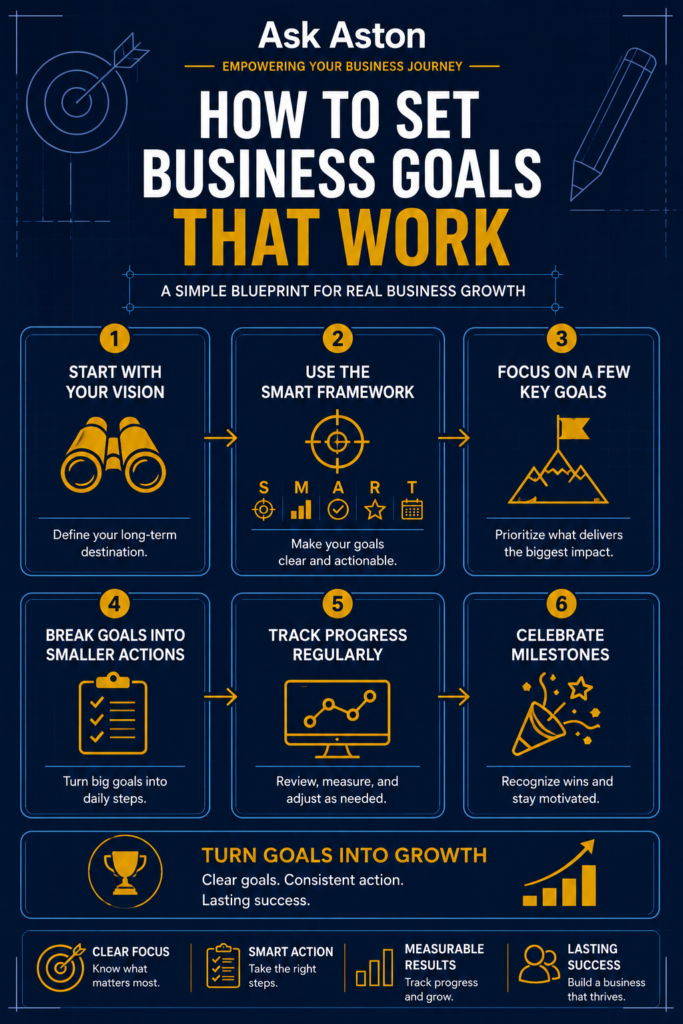
Start With Your Long-Term Vision
Before setting short-term goals, think about where you want your business to be in the future.
Ask yourself questions such as:
- What do I want my business to achieve in the next three to five years?
- How many customers do I want to serve?
- What level of revenue would represent success?
- What kind of lifestyle do I want this business to support?
Your answers create a foundation for future planning.
Once you understand your long-term vision, you can develop smaller goals that move you closer to it.
Use the SMART Goal Framework
One of the most effective goal-setting methods is the SMART framework.
SMART goals are:
Specific – Clearly define what you want to accomplish.
Measurable – Include numbers or milestones you can track.
Achievable – Set goals that challenge you without becoming unrealistic.
Relevant – Align goals with your overall business strategy.
Time-Bound – Establish a deadline for completion.
For example, instead of saying, “I want more customers,” a SMART goal would be: “Acquire 20 new customers within the next three months.”
Because SMART goals provide clarity, they often produce better results than vague objectives. Read more about setting SMART goals here.
Focus on a Few Important Goals
Many new entrepreneurs make the mistake of pursuing too many goals at once.
Although ambition is valuable, excessive goals can create confusion and reduce productivity. Therefore, focus on a small number of priorities.
Choose goals that will have the greatest impact on your business. For example, increasing revenue, improving customer retention, or launching a new product may deserve more attention than less critical tasks.
By concentrating your efforts, you can make faster progress and maintain momentum.
Break Large Goals Into Smaller Actions
Big goals often feel overwhelming. However, breaking them into smaller steps makes them easier to achieve.
For instance, if your goal is to increase website traffic by 50 percent, create smaller action items such as:
- Publish one article each week.
- Improve website SEO.
- Share content on social media.
- Build an email list.
Each completed action moves you closer to the larger objective.
Furthermore, small wins create motivation and build confidence over time.
Track Progress Regularly
Goals only work when you review them consistently.
Set aside time each week or month to evaluate your progress. During these reviews, compare actual results to your targets and identify areas that need improvement.
Regular tracking helps you stay accountable. Additionally, it allows you to adjust your strategy when circumstances change.
Business conditions rarely remain static. Therefore, flexibility is an important part of effective goal setting.
Celebrate Milestones Along the Way
Many entrepreneurs focus so heavily on the next objective that they forget to recognize progress.
Celebrating milestones can boost motivation and reinforce positive habits. Whether you reach a sales target, launch a new product, or complete a major project, take time to acknowledge the achievement.
These moments remind you that consistent effort leads to meaningful results.
Turn Goals Into Growth
Setting business goals is not simply an exercise in planning. It is a practical way to create focus, accountability, and momentum.
By defining a clear vision, using the SMART framework, prioritizing key objectives, and tracking progress regularly, you can build goals that drive real results. Over time, these habits help transform ideas into achievements and support long-term business growth. For more ideas on what successful entrepreneurs do differently, click the link.
Need help setting goals and creating a business plan?
Try Ask Aston to brainstorm ideas, validate opportunities, create business plans, and get step-by-step guidance tailored to your goals.